
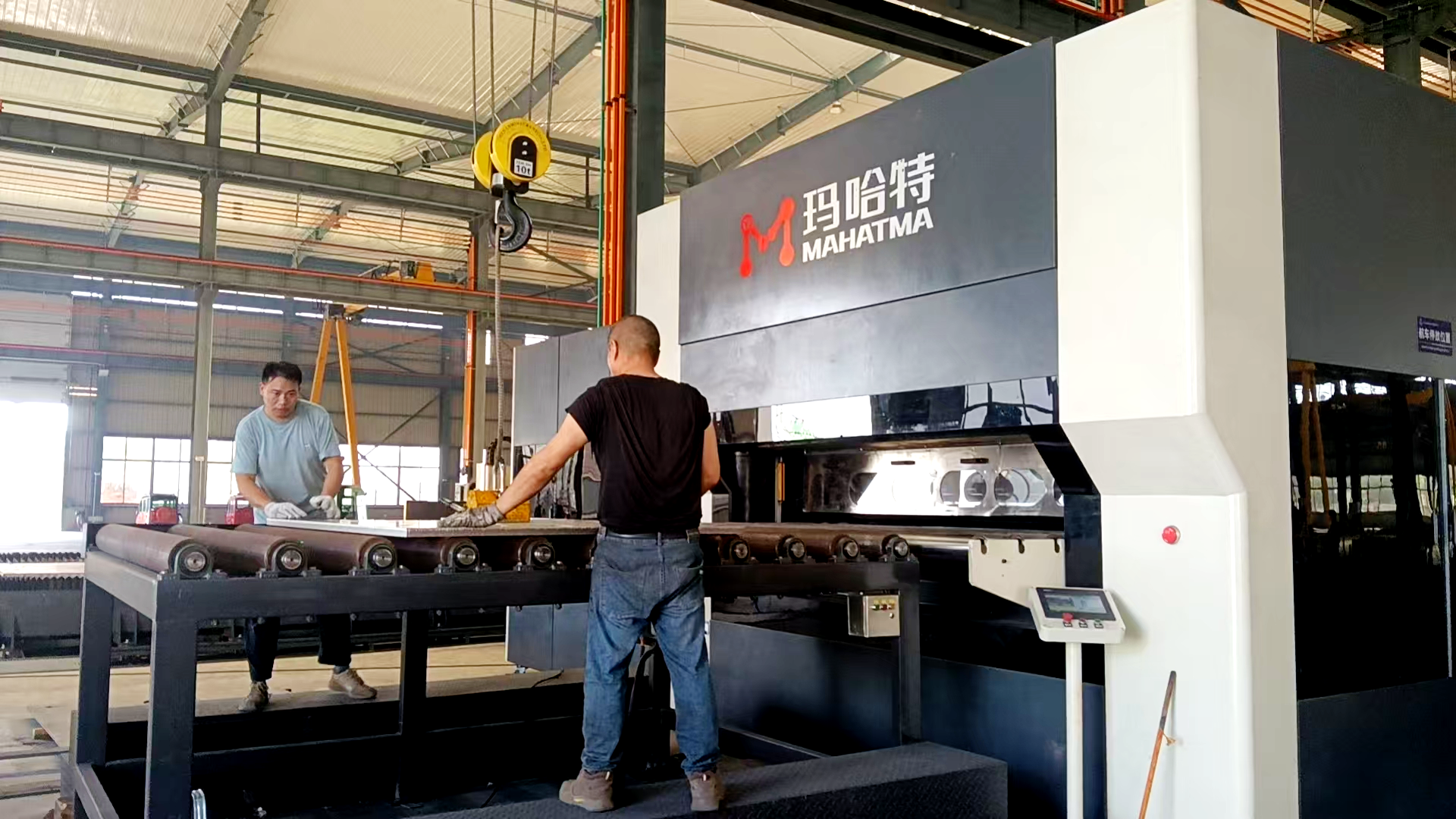
In today’s fiercely competitive manufacturing industry, the precision of materials often determines the quality and performance of products. Whether it is precision components in high-end electronic devices or key structural components in the aerospace industry, even small errors can cause serious problems. As the “guardian of precision” in the field of material processing, precision levelers are relying on their excellent technology to bring material accuracy back to “zero error” and provide solid support for the high-quality development of various industries.
1、 Working principle of precision leveling machine
The working principle of precision leveling machine is based on a precise grasp of the mechanical properties of materials. It mainly uses a series of precision rollers to repeatedly bend and stretch the material, utilizing the “Bauschinger effect” of the material, which means that the yield strength of the material changes during plastic deformation, and decreases when the loading direction changes. During this process, the stress distribution inside the material gradually becomes uniform, thereby eliminating the internal stress and surface unevenness generated during rolling or cutting.
For example, for a metal sheet with wavy or warped patterns, the rollers of a precision leveler will apply precise pressure and bending force to the sheet according to a pre-set program. The diameter, spacing, and pressure of the rollers have been carefully designed and optimized to ensure that the sheet can be uniformly stressed in all directions when passing through the roller group, thereby achieving high-precision leveling. This precise control enables the precision leveler to control the flatness accuracy of the sheet within a very small range, such as ± 0.01mm or even higher.
2、 Technical features of precision leveling machine
(1) Intelligent hydraulic system
The precision leveling machine with intelligent hydraulic system as its core has the advantage of infinite pressure regulation. Through a multi-stage hydraulic servo system, the pressure between the rollers can be dynamically adjusted to accurately adapt to different materials and thicknesses of sheets, with pressure fluctuations ≤ 1%. This means that it can perform a “micrometer level gentle touch” on extremely thin materials to avoid crushing, and can also perform a “thousand ton level reshaping” on thick plates to ensure sufficient leveling. At the same time, combined with dynamic compensation and intelligent correction functions, it is equipped with a dual sensing system of laser thickness gauge and infrared stress detection, which scans the deformation of the sheet in real time and automatically optimizes the hydraulic pressure curve every 0.02 seconds, effectively solving the pain point of “head to tail error” in traditional mechanical leveling and greatly improving the consistency of the finished product.
(2) Multi dimensional sensing technology
The precision leveling machine integrates multi-dimensional sensing technology, such as laser ranging, infrared thermal imaging, and strain analysis modules, which can capture material stress distribution and micro deformation in real time with an accuracy of ± 0.005mm. These sensors are like the “eyes” and “nerve endings” of the equipment, quickly feeding back the collected data to the control system, allowing the equipment to adjust leveling parameters in a timely manner according to the actual situation of the material, and achieve precise leveling operations. This dynamic adjustment based on real-time data greatly improves the accuracy and stability of leveling, ensuring that every piece of material can achieve the desired flatness.
(3) Surface zero damage technology
For some materials that require extremely high surface quality, such as mirror panels, etched copper plates, etc., the precision leveling machine adopts a nano ceramic coating roller system and hydraulic flexible buffering technology. The surface roughness Ra of the leveled plate is ≤ 0.2 μ m. This technology not only ensures the flatness of the material, but also ensures that the surface is free of indentation and scratches, meeting the strict processing requirements for smoothness. It allows the material to directly enter subsequent processes such as electroplating or spraying, reducing additional surface treatment costs and time.
(4) Equipment integration and intelligent operation and maintenance
Precision leveling machines typically integrate advanced PLC control systems and intuitive touchscreen interfaces, supporting the storage, retrieval, and remote cloud monitoring of process parameters. By integrating a large number of fault simulation databases, hydraulic valve wear and abnormal oil temperature can be alerted 48 hours in advance, achieving fault prediction and unmanned production. In addition, the patented quick change roller box design can compress the specification switching time to extremely short, significantly improving the flexibility of the production line and adapting to diverse production needs.
3、 Application Fields of precision leveling machine
(1) Manufacturing of new energy vehicles
The flatness of aluminum alloy sheet is crucial in the production of battery trays for new energy vehicles. Welding stress and other factors can easily cause deformation of the plate, but the precision leveling machine can level the flatness of the 2.5mm aluminum alloy box to 0.1mm, greatly improving the laser welding yield from 88% to 99.3%, and reducing scrap losses by 12 million yuan per year. For high-strength steel used in automobile body manufacturing, precision leveling machines can also leverage their advantages to ensure high precision of body components, improve the safety and assembly quality of the entire vehicle.
(2) Consumer electronics industry
Taking the foldable screen mobile phone hinge component as an example, a domestic brand introduced electromagnetic pulse leveling technology to solve the problem of leveling and rebounding of 0.12mm ultra-thin stainless steel. By using microsecond level electromagnetic fields to accurately eliminate internal stress, the flatness of the hinge was pushed to the level of 5 microns, directly challenging industry-leading technology. In the processing of ultra-thin materials such as 5G base station heat dissipation copper sheets (thickness 0.08mm) and flexible circuit board support layers, precision levelers effectively eliminate stress deformation by using 30mm diameter micro ceramic rollers (hardness HRC90) and constant temperature oil mist lubrication technology, meeting the demand for high-precision and high-performance materials in the consumer electronics industry.
(3) Aerospace field
The aerospace industry has almost strict requirements for the accuracy and quality of materials. During the curing process, carbon fiber prepreg is prone to deformation due to uneven resin distribution. The precision leveling machine can eliminate this deformation through temperature pressure coordinated control, increasing the dimensional stability of the component by 40%, reducing the weight of key components such as the support satellite solar wing substrate by 15%, and increasing the stiffness by 22%. For materials such as titanium alloy skin, the surface roughness Ra after leveling is ≤ 0.8 μ m, which meets the aerodynamic requirements for supersonic flight and provides reliable guarantees for the safety and performance of aircraft.
(4) Other fields
In ship engineering, the pressure resistant steel plate (EH36 grade) for ships can eliminate residual stress in 50mm thick plates and reduce welding deformation rate by 60% after being processed by a precision leveler, improving the strength and stability of ship structures. In the field of intelligent warehousing, AGV shelves support steel beams that are precisely leveled to meet EN10029 standards, extending the shelf system’s lifespan by 8 years. In addition, precision leveling machines also play an important role in industries such as medical devices and precision mold manufacturing, providing indispensable support for high-precision manufacturing of products.
4、 The value brought by precision leveling machine
(1) Improve product quality
The precision leveling machine controls the material accuracy at a “zero error” level, ensuring high precision of product components, thereby improving the quality and performance of the entire product. Whether in the high-end manufacturing field or industries with strict requirements for product quality, this advantage has won market competitiveness for enterprises.
(2) Reduce production costs
By improving material utilization and product yield, precision levelers reduce waste and rework, lower material waste and production costs. At the same time, its efficient production capacity and low energy consumption characteristics further save the operating costs of the enterprise. For example, a certain recycled aluminum processing enterprise used high-precision leveling machines to increase the utilization rate of recycled aluminum plates from 63% to 91%, reducing processing losses by 28 kilograms per ton of recycled aluminum.
(3) Promote industrial upgrading
As a representative of advanced manufacturing technology, precision leveling machines have been widely used to promote the upgrading of various industries towards high-precision and intelligent manufacturing. It provides the possibility for the application of new materials, promotes product innovation and technological progress, and helps enterprises seize the initiative in global manufacturing competition.
In the modern manufacturing industry that pursues ultimate precision, precision leveling machines have become an indispensable key equipment. It injects strong impetus into the high-quality development of various industries by bringing material accuracy back to “zero error” with excellent technology. With the continuous advancement of technology, precision levelers will continue to innovate and play a greater role in a wider range of fields, leading the manufacturing industry to new heights.