
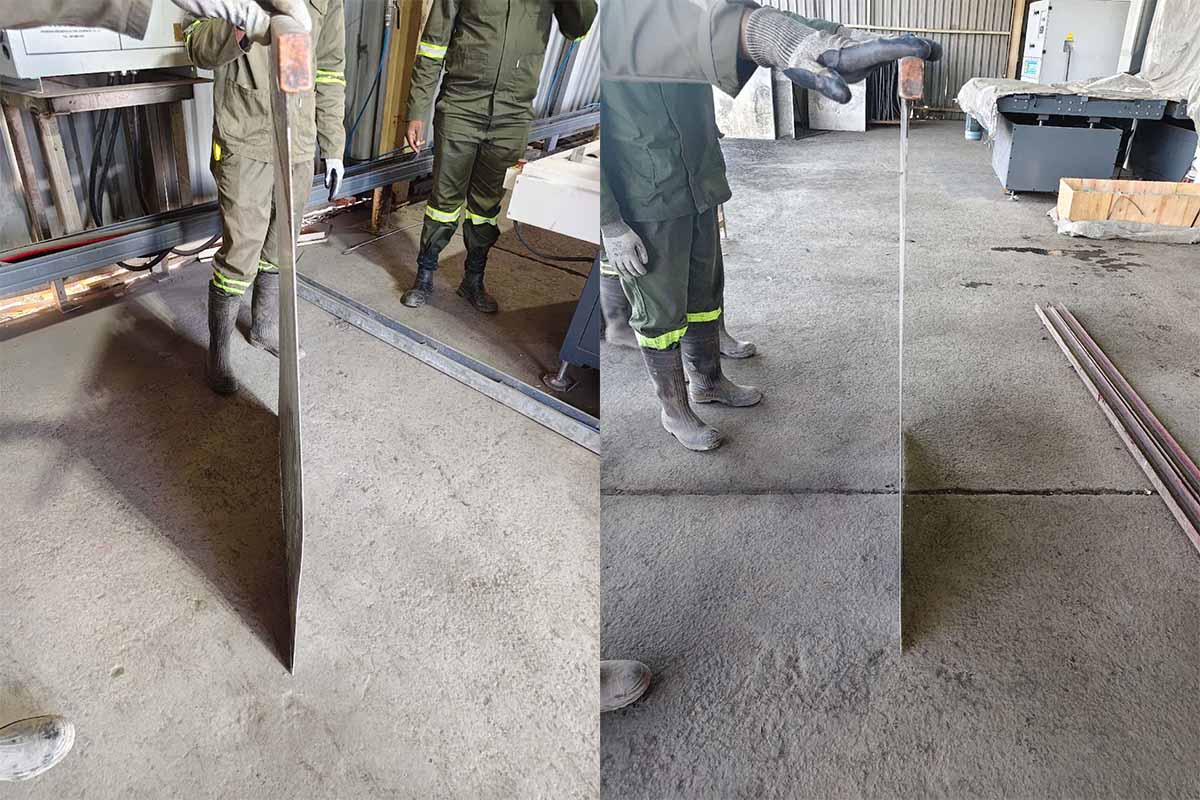
In modern industrial production, stainless steel cathode plates are the backbone of many processes, from electrochemical applications to advanced fabrication lines. Yet even the most carefully manufactured plates can suffer from thickness deformation, warping, or wave-like distortions during handling, storage, or machining. For a plate measuring 3.2 mm thick, 1200 mm wide, and 1400 mm long, such deformation is not just a cosmetic issue—it directly impacts assembly accuracy, operational efficiency, and long-term reliability.
Our precision leveling and repair solution is designed to restore these plates to their optimal flatness. Unlike conventional straightening methods that risk surface damage or uneven stress distribution, our system employs multi-roll precision leveling technology combined with automatic pressure control. This ensures that even large-format plates can be corrected in a single pass, achieving mirror-like flatness without scratches, dents, or residual stress. The result is a cathode plate that not only looks flawless but also performs flawlessly in demanding industrial environments.
Key advantages include:
One-pass correction for large plates, minimizing downtime.
Flatness restored to ≤0.3 mm, ensuring consistent assembly and welding quality.
Surface protection layers that prevent pressure marks or abrasions.
High repeatability, enabling batch processing with uniform results.
For customers, this means reduced scrap rates, smoother downstream processing, and higher confidence in product quality. Whether used in electrochemical refining, precision stamping, or heavy-duty fabrication, a leveled cathode plate translates into measurable gains in productivity and cost savings.
By choosing our 3.2 mm stainless steel cathode plate leveling and repair service, you are not just fixing a defect—you are investing in efficiency, reliability, and industrial excellence. Large-size deformation repair is no longer a challenge; it is an opportunity to demonstrate the strength of advanced manufacturing technology.